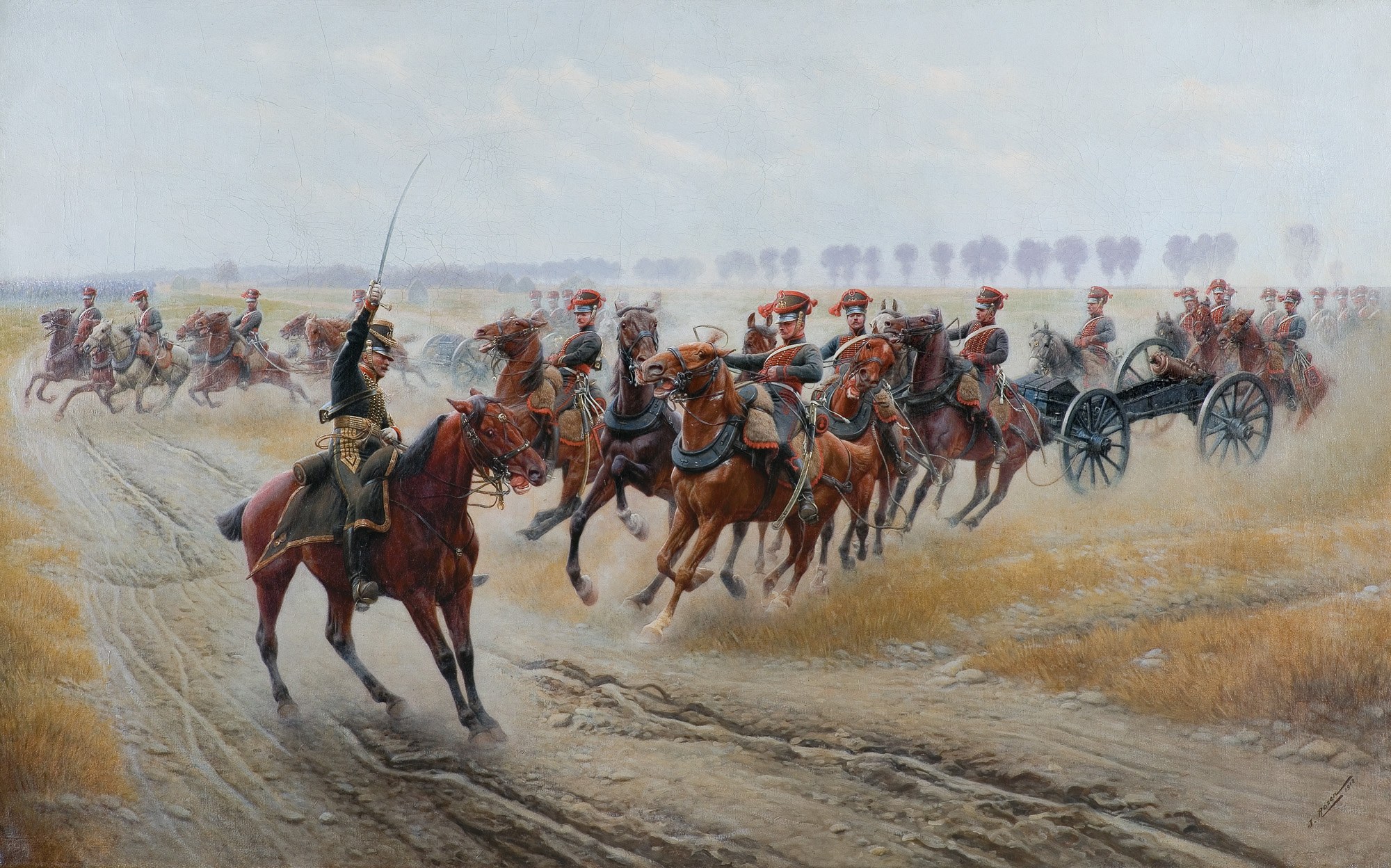
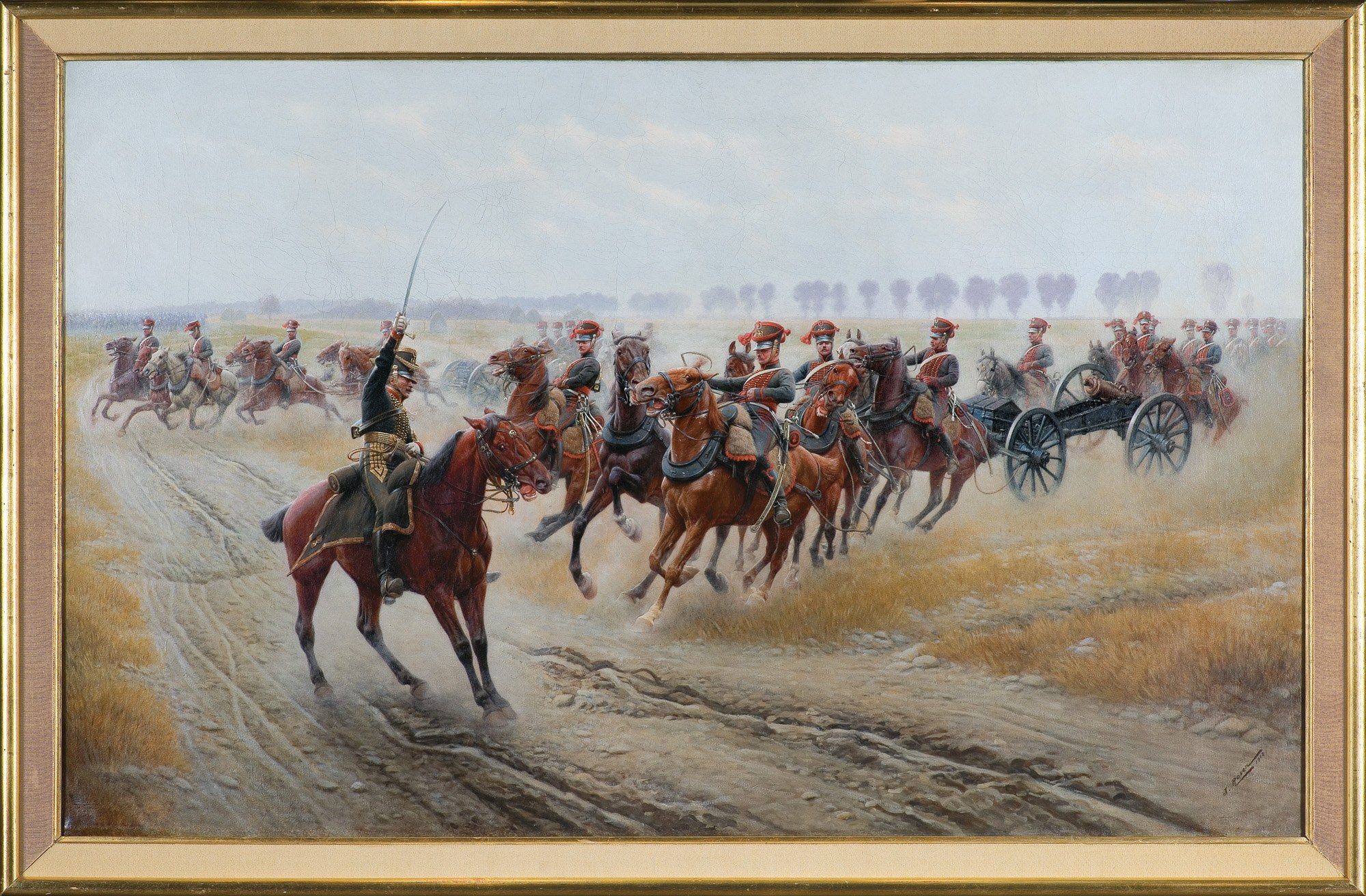
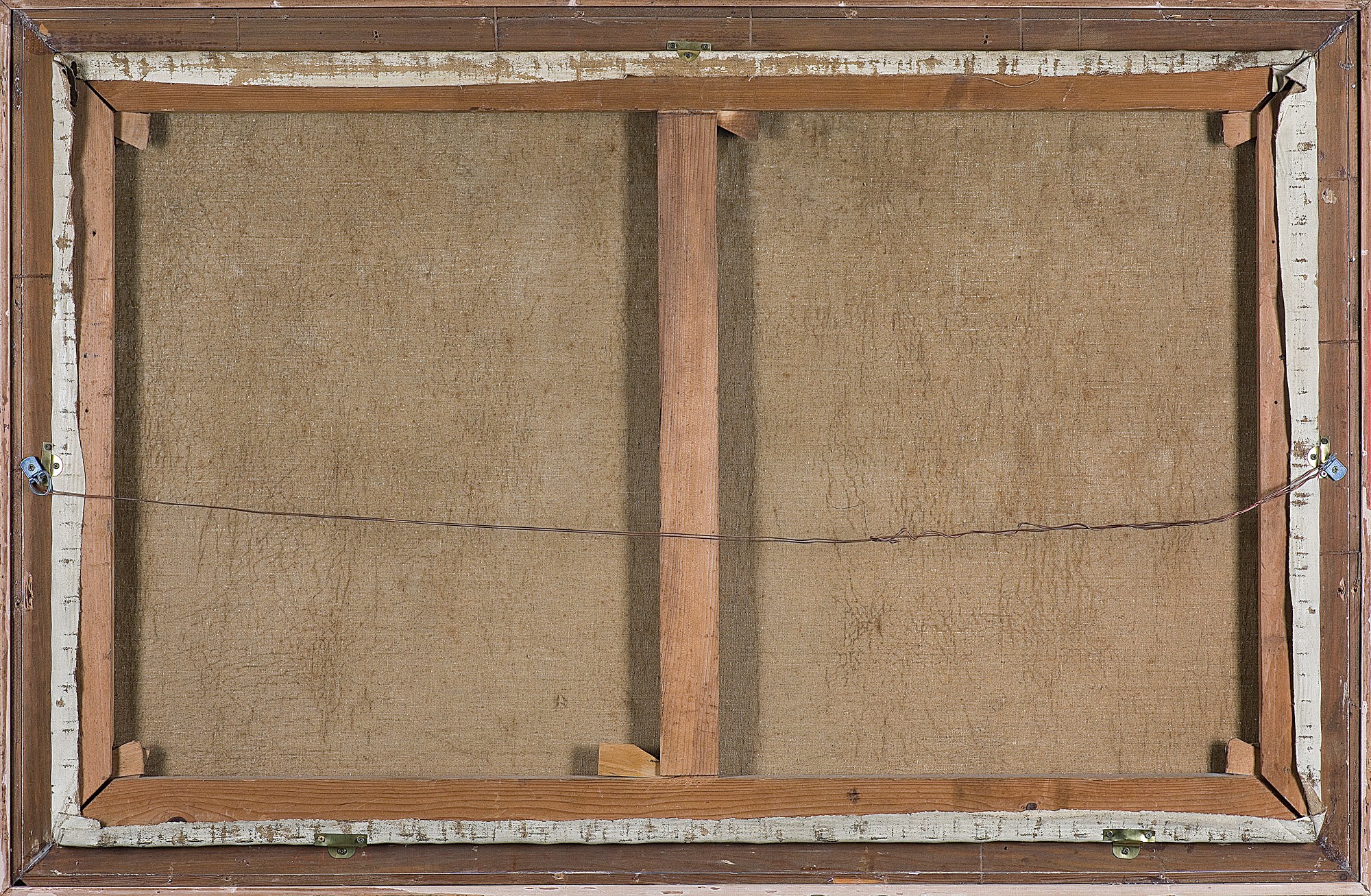
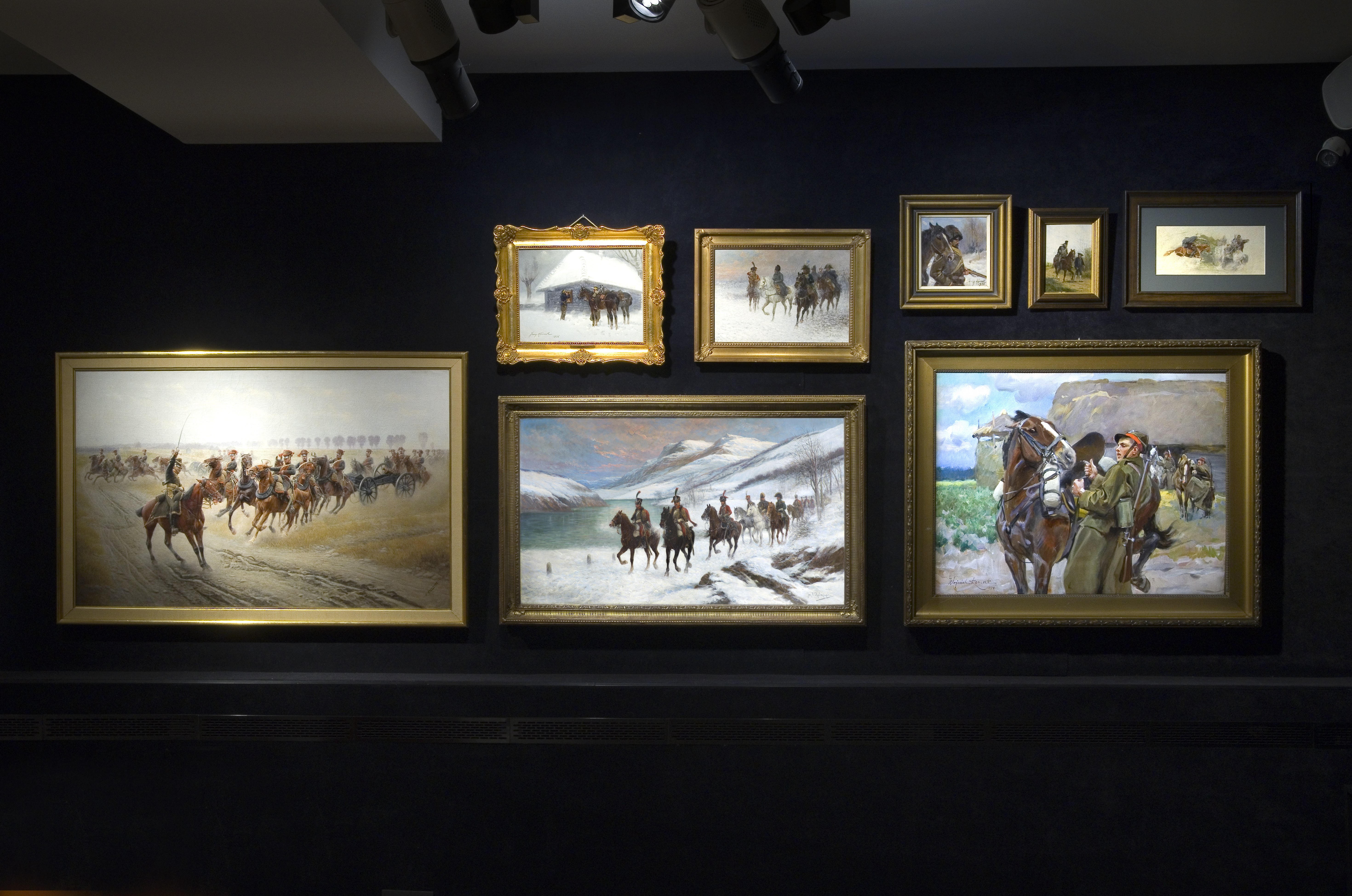
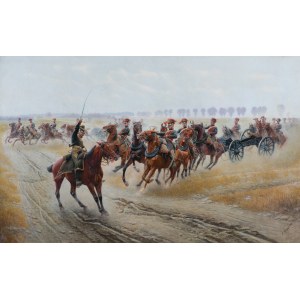
76 x 121.5 cm - oil on canvas
signed lower right: J. Rosen 1918
In 1893, the artist exhibited a painting titled *Halt!* at the Glaspalast in Munich. A reproduction of the work appeared in the exhibition catalog. That same year, in its 201st issue dated October 23 (November 4), *Tygodnik Ilustrowany* published a photograph of the artist’s studio, in which a second, slightly altered version of the same composition stands on an easel. The canvas shown above, however, is the third known version of the work depicting horse artillery.
Jan Rosen ranks among the most important Polish battle painters of the second half of the 19th and early 20th centuries. His work focused primarily on military themes, with a particular fondness for scenes related to the Napoleonic era, the November Uprising, and the history of Polish military formations.
Horses and riders also played a significant role in his work, allowing his paintings to combine the precision of a historical document with the dynamism of a battle scene. The artist studied in Munich, including at Józef Brandt’s private studio, and later at the École des Beaux-Arts in Paris under Isidore Pils and Jean-Léon Gérôme. All these experiences influenced his passion for detail, accurate drawing, and the striking yet carefully thought-out composition of his scenes.
The artist specialized in depictions of the military, cavalry, and scenes inspired by military history, creating paintings characterized by extraordinary attention to historical detail. The subject of his works was primarily military scenes, reconstructed with such impressive precision that they give the impression of being observed directly from life. In his compositions, one can easily spot details that allow one to identify a specific formation, era, or type of military unit. His interest in military matters was so deep that he also owned a collection of historical artifacts and weapons.
"Halt!" is an excellent example of the artist’s passion for the details of historical uniforms, weaponry, and horse gear. The scene itself served as a pretext for an exceptionally faithful recreation of military equipment—every button, every piece of embroidery, every buckle. In this regard, the artist achieved impressive expertise in costume design and masterful precision. Another hallmark of Rosen’s work is his mastery in depicting horses. The artist was able to render their anatomy, build, and the dynamics of their movement with extraordinary precision. In the depicted battle scene, the horses are not merely a complement to the depiction but become its equal protagonists, actively participating in the operation. Their silhouettes, rendered with a deep understanding of anatomy and keen observation, help create the atmosphere and emphasize the dynamism of the entire composition. The combination of a realistic study of the riders and horses with an evocatively rendered landscape allowed Rosen to create a work of great expressive power, which is an excellent example of his individual and easily recognizable style.
Compare with: – *Illustrirter Katalog der Münchener Jahresausstellung von Kunstwerken aller Nationen im Kgl. Glaspalast*, Munich 1893, p. 69, cat. no. 1269, ill. no. 30. (“Halt!”);
– “Tygodnik Ilustrowany,” 1896, No. 39, p. 757 (engraving based on the painting);
– Jan Rosen, “Stop!”, “Tygodnik Ilustrowany,” 1893, No. 201, p. 296. (photograph of Jan Rosen’s studio).
Jan Rosen (Warsaw 1854–Warsaw 1936), a popular battle painter, took his first drawing lessons as a child—from Henryk Redlich in Dresden and Franciszek Kostrzewski in Warsaw. Later, from 1872 to 1874, he studied in Munich—at the Academy under Alexander Strähuber and the sculptor Ferdinand Barth, as well as in Józef Brandt’s private studio, and from 1875 to 1879 at the École des Beaux-Arts in Paris under Isidor Pils and Jean-Léon Gérôme. He spent a long time abroad and traveled extensively; he lived in Munich, Paris, and Lausanne. In 1891, he became a court painter at the St. Petersburg court. He returned to Poland in 1921; initially he lived in the countryside, and later in Warsaw and Lviv. He also traveled to Italy. He painted primarily military-themed works, battle scenes from the Napoleonic era and the November Uprising, as well as genre paintings featuring his favorite motif of horsemen and horses.










Naposledy prohlížené
Chcete-li vidět seznam položek, přihlaste se
Oblíbené
Chcete-li vidět seznam položek, přihlaste se