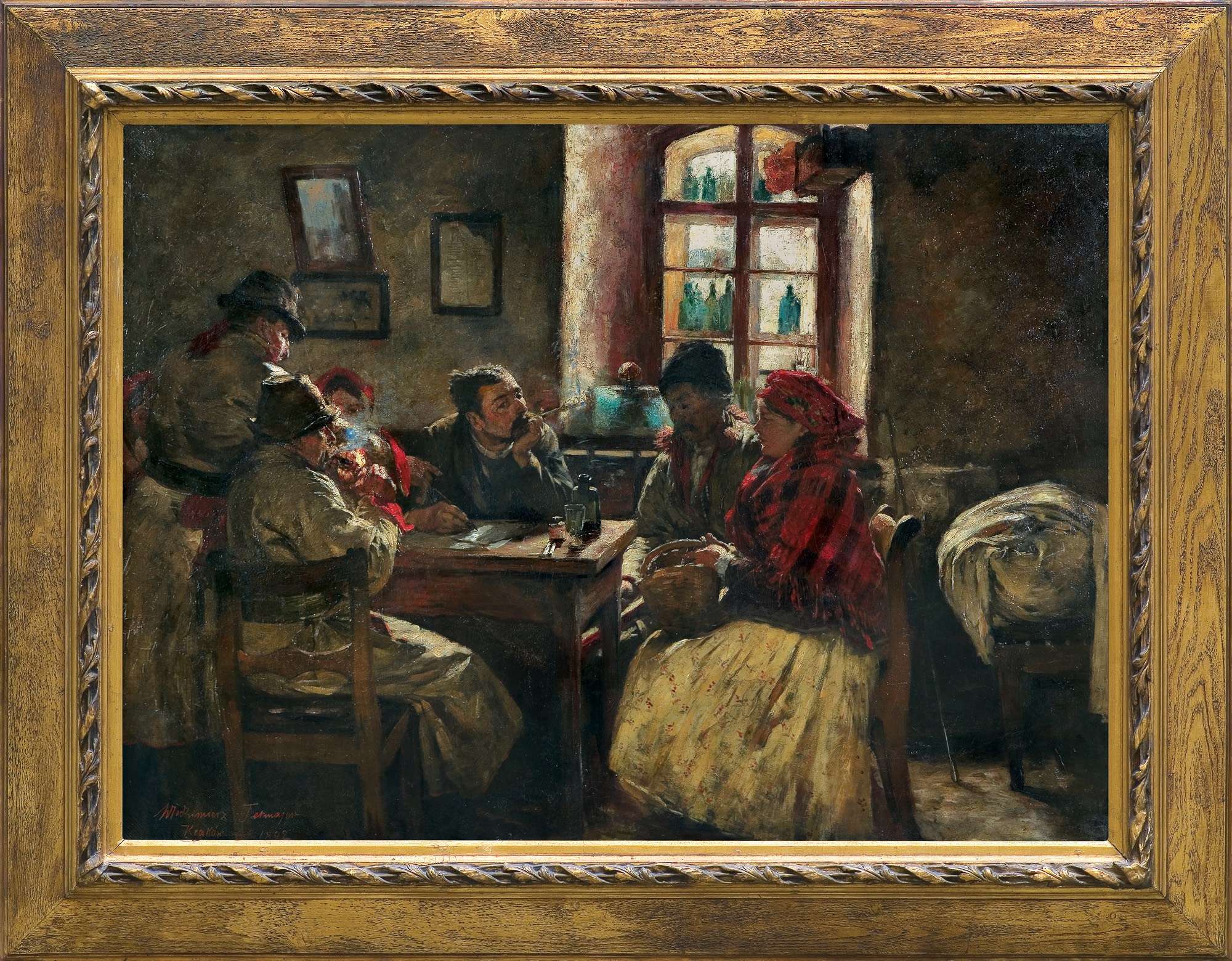
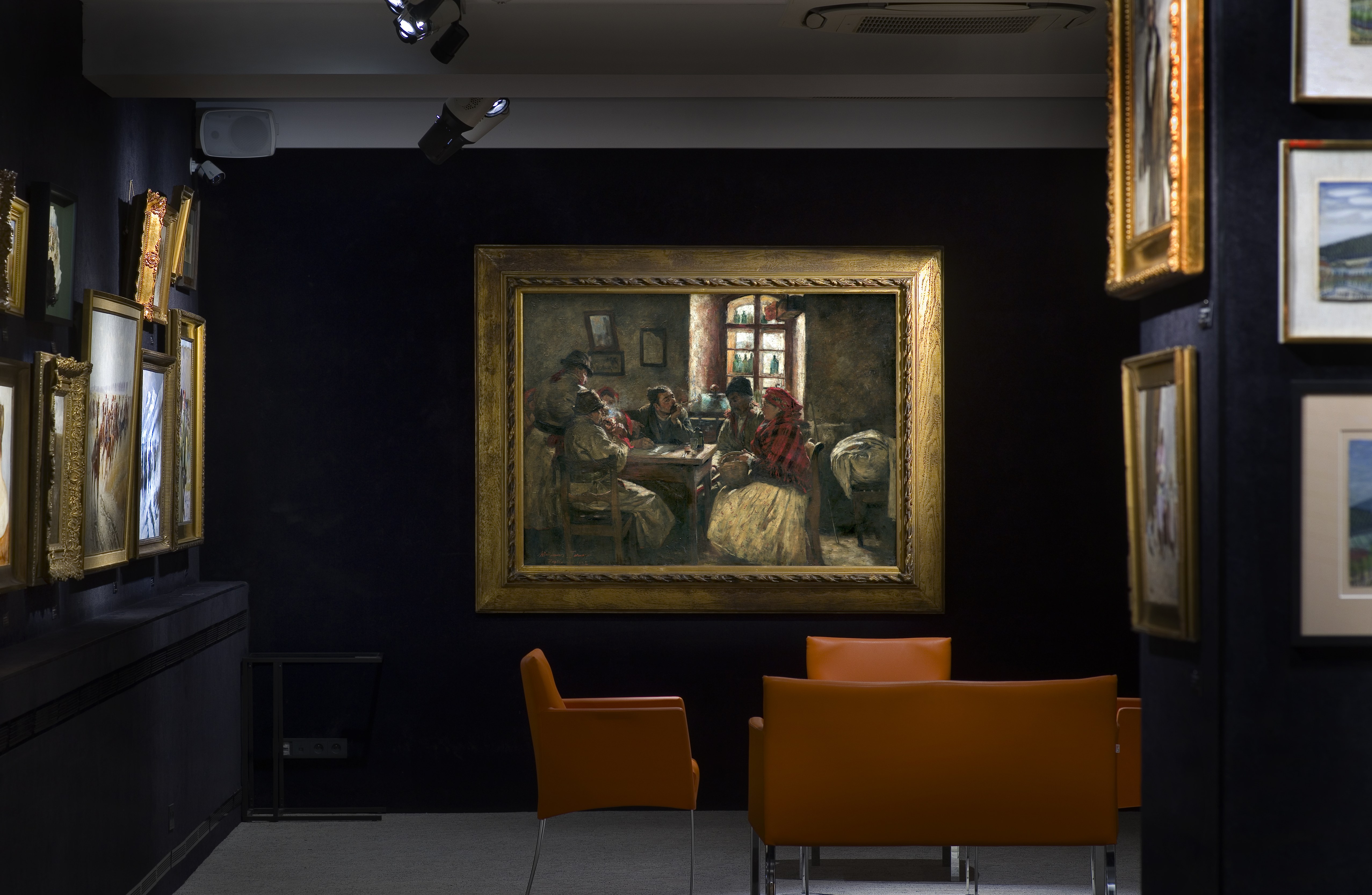
110.5 x 150.5 cm - oil on canvas
other titles: The Back-Alley Scribe, The Village Clerk, The Country Lawyer, The Village Scribe
signed lower left: Włodzimierz Tetmajer | Kraków – 1892
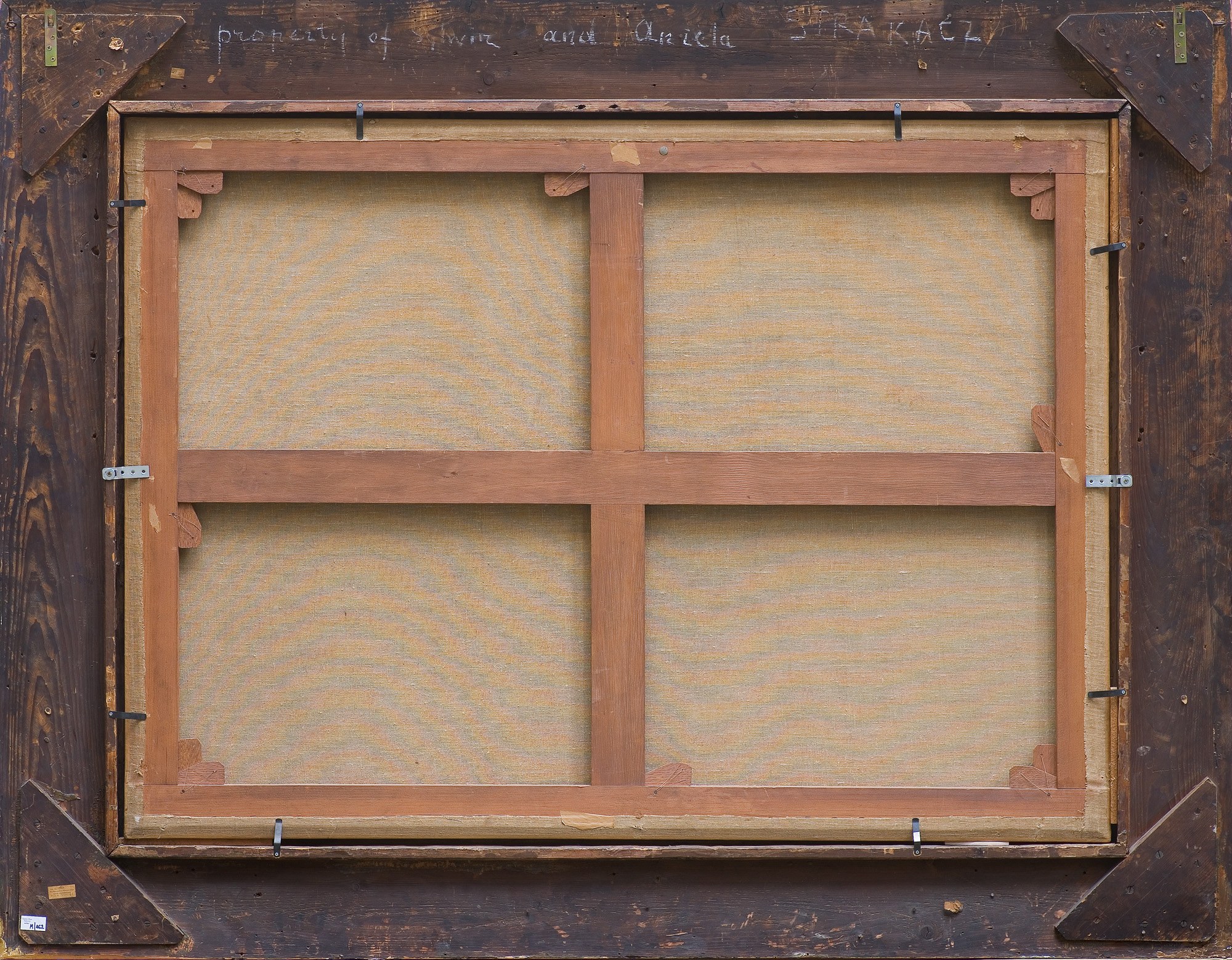
On the frame, lower left: a white, serrated paper sticker from the temporary exhibition “Polish Painting” at The Metropolitan
Museum of Art, numbered 3889, and a white paper sticker from an auction house, numbered M/162;
in the lower right corner, a white paper sticker with “B2” written in black ink;
along the top rail of the frame, an inscription in white chalk: “property of Sylwin and Aniela STRAKACZ.”
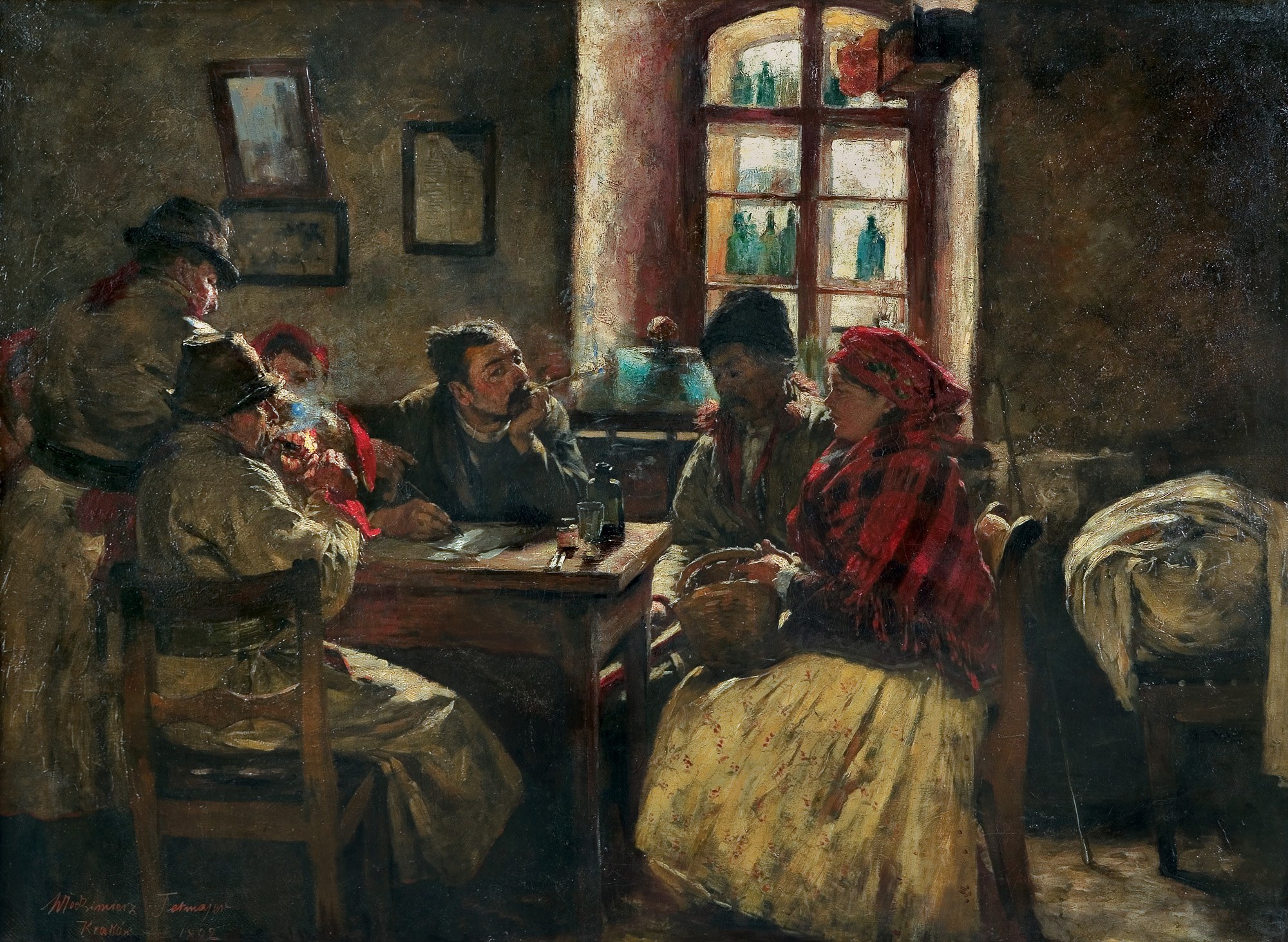
The painting *Rural Scribe* (also known as *Rural Lawyer*) is one of the most famous, monumental, and exceptional works in Włodzimierz Tetmajer’s early artistic output. Almost immediately after it was painted, the canvas was exhibited at the World’s Fair in Chicago and in Philadelphia, where the artist won a silver medal for it. In the years that followed, *The Scribe* was exhibited numerous times, reproduced, and widely discussed in the art literature. The work also has an interesting provenance—it was part of two famous private collections: first in the collection of Sylwin and Aniela Strakacz, and then in the outstanding collection of Zbigniew Mikulski.
It must be strongly emphasized that *The Country Scribe* is a canvas from the artist’s early period, from which relatively few paintings have survived to this day, and the vast majority of them have been lost. This makes the canvas on offer a priceless, one-of-a-kind work—a painting of the highest artistic caliber that perfectly exemplifies the outstanding talent of a young yet fully mature artist.
*The Village Scribe* was painted during a pivotal period in the artist’s life and career, when Włodzimierz Tetmajer had already settled permanently in Bronowice, near Kraków. It is one of his earlier, famous compositions belonging to the so-called “Bronowice” cycle. It was created at a time when the artist was already a full-fledged member of the Bronowice community. From 1890 onward, the village near Kraków became for Włodzimierz Tetmajer a place to live, not merely a source of inspiration. The painter did not come here as an ethnographer or a summer visitor, but rather immersed himself in the heart of the rural community—he married the daughter of a local peasant, Anna Mikołajczykówna, started a family, participated in daily activities, festivals and rituals, and became familiar with the local language, customs, and social hierarchies. His painting was already artistically mature at that time, highly individualized, with a refined and fully autonomous style. However, *The Village Scribe* was created while the artist was still in his Kraków studio, located in rented rooms at the School of Fine Arts on Kleparz Street, even before he had finally set up his own famous studio in Bronowice. Antoni Kowalski posed for the artist as the seated, eponymous scribe; his likeness can also be recognized in the artist’s other works.
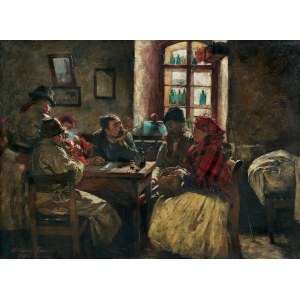
Painted in a realistic style, this elaborate genre scene unfolds in the dim light of a rural room, likely an inn. The subject of the work is the so-called “signing of a contract” —a depiction of a moment of great importance in the lives of Bronowice’s residents, likely concerning the legal registration of land or property. The titular rural scribe sits at a small wooden table. The protagonist of the painting is an exceptionally interesting figure. The scribe—a literate man, a mediator between the official world and the rural community—was among the most important figures in the village at that time. He wrote letters, petitions, and wills; read documents aloud; assisted with official matters; and was often the confidant of family secrets and local history. He represented a kind of rural elite—a man endowed with authority stemming from his knowledge and skills. The man, before whom lies a written sheet of paper, holds a pen in one hand and a cigarette in the other, listening intently to the peasant leaning over him. The peasant, gesturing animatedly, is clearly pointing something out to him and explaining the intricacies of the transaction being concluded. Seated on opposite sides of the table are two pairs of peasants, who are presumably the two parties to the contract being drawn up. The men present are dressed in distinctive, traditional smocks and wear wide-brimmed felt hats on their heads. The woman sitting in the foreground, however, is dressed in a colorful Bronowice outfit—a checkered scarf and a bonnet made from a patterned scarf.
The room is shrouded in deep twilight. The sharp rays of the midday sun streaming through a single small window clearly illuminate the tabletop and cast luminous reflections on the figures and household items. The artist’s treatment of the window scene is particularly interesting. Placed in its light on the window sills, green and brown glass bottles take on intense, almost pure hues. This seemingly trivial element of genre observation becomes an important chromatic accent in the composition and foreshadows Tetmajer’s growing interest in light and color. The composition also draws attention to the masterful rendering of the figures “backlit,” a technique already present in several other outstanding paintings by Tetmajer from his early period, such as the well-known work *Neapolitan Tavern*. This technique stems directly from his studies of light and Post-Impressionist experiments with color, which gave rise to his individual painting style, in which intense patches of color play a central role.
The vivid color palette of the compositions—as Marta Marek notes—which depict colorful rituals and scenes from the daily lives of peasants near Kraków, sometimes leads to Włodzimierz Tetmajer’s works being perceived rather superficially —as charming, idyllic anecdotes. In reality, Tetmajer’s canvases go far beyond a decorative form: they contain a profound, universal study of the human condition. The artist’s keen and empathetic eye is particularly evident in works created before 1900. As Marta Marek writes: The secret lies in the flawless observation and recreation of details that attest to the harsh, austere living conditions —worn, large peasant hands, huge feet, clumsy gestures—the depiction of which is accompanied by the use of formal devices, such as the textured surfaces of the canvases (M. Marek, P. Hapanowicz, Włodzimierz Tetmajer. The Power of Colors, p. 23).
These words describe Wiejski’s “Scribe” almost perfectly. This early composition, under the guise of a tranquil genre scene, subtly conveys the truth about peasant toil and the gravity of the struggle for every morg of land. The harsh features of the peasants’ faces and their stiff postures are not an idyll, but rather a cool objectivity rooted in the Verism movement, which the artist adopted through his acquaintance with Aleksander Gierymski. The brutality of the brushwork and the rough painterly texture, which Marta Marek mentions later, heighten the work’s expressiveness. The researcher concludes her argument by stating that the thick, layered paint forming lumps—as a means of expression—further brings out and reinforces a certain kind of truth about the world depicted in the painting (Ibid., p. 24).
It is precisely this raw, unvarnished truth that makes *The Scribe* such an outstanding, authentic, and poignant work by one of the most distinguished artists of the Young Poland period.
Provenance: – Auction of works by Polish artists participating in the World’s Columbian Exposition in Chicago,
New York, April 25–26, 1895;
– Private collection in the United States;
– Owned by Sylwin and Aniela Strakacz; Sylwin Strakacz (1892–1973)—editor-in-chief of *Rzeczpospolita*,
composer, diplomat, consul general in Geneva and New York, personal secretary and executor
of Ignacy Jan Paderewski’s will;
– Collection of Zbigniew Mikulski (1925–2017) in St. Gallen, Switzerland;
– Since 2019, in a private collection in Poland.
The painting has been exhibited, mentioned, and reproduced in, among others: – World’s Columbian Exposition, 1893: official catalog. Part X. Department K. Fine Arts, W.B. Conkey, Chicago 1893, p. 175, cat. no. 113 (The Penman).
– World’s Columbian Exposition. Official publication. Revised Catalogue. Department of Fine Arts with Index of Exhibitors, W. B. Conkey Company, Publishers to the Exposition, Chicago 1893, p. 430, cat. no. 73 (The Penman);
– W. Walton, *Art and Architecture. World’s Columbian Exposition MDCCCXCIII. Official Illustrated Publication*, Philadelphia: George Barrie & Son (1893), p. 76 (The Penman);
– “Zgoda,” 1893, Vol. 12, No. 19, p. 3;
– California Midwinter International Exposition, Official Catalog, Department of Fine Arts, Golden Gate Park, San Francisco, December 1, 1893 – July 4, 1894, p. 59, cat. no. 626 (The Penman);
– Report of the Board of Directors of the United Society of Friends of the Fine Arts in Kraków on Activities for the Year 1893, Kraków 1894, p. 13, cat. no. 355;
– E. Swieykowski, Memoirs of the Society of Friends of the Fine Arts in Kraków 1854–1904, Society of Friends of the Fine Arts, Kraków 1905, p. 294 (The Secret Writer);
– B. Mastai (ed.), *Nineteenth-Century Polish Paintings: A Loan Exhibition*, The Metropolitan Museum of Art, New York 1944, p. 12, p. 40, cat. no. 57, b&w ill. (*The Village Scribe*);
– M. Lotrange, “Nineteenth-Century Polish Paintings at The Metropolitan Museum of Art,” *The Polish Review*, Vol. IV, No. 9, March 7, 1944, pp. 8–11, p. 11 (The Village Scribe);
– J. Dużyk, “Fame, Mr. Włodzimierz: A Story About Włodzimierz Tetmajer,” 2nd expanded ed., Włodzimierz Tetmajer Foundation, “Czuwajmy” Publishing House, Kraków 1998, p. 107 (“The Secret Scribe”);
– J. A. Nowobilski, Włodzimierz Tetmajer (1861–1923), Włodzimierz Tetmajer Foundation, “Czuwajmy” Publishing House, Kraków 1998, p. 25 (The Secret Scribe,
dated 1891);
– B. Pranke, The Trend of “Peasant Mania” in the Works of Stanisław Radziejowski, Ludwik Stasiak, Włodzimierz Tetmajer, Wincenty Wodzinowski, and Kacper Żelechowski, Neriton, Warsaw 2003, p. 92;
– A. M. Drexlerowa, A. K. Olszewski, Poland and the Poles at World’s Fairs, 1851–2005, Institute of Art of the Polish Academy of Sciences, Warsaw 2005, p. 154, 155 (Rural Writer);
– A. M. Drexlerowa, A. K. Olszewski, Polish Participation in World Exhibitions 1851–2005, Ministry of Culture and National Heritage, Warsaw 2008, p. 215 (The Penman);
– S. Dziedzic, Włodzimierz Przerwa-Tetmajer: on the ninetieth anniversary of the death of the artist and politician, “Niepodległość i Pamięć,” vol. 21, no. 3–4 (47–48), pp. 9–48, 2014, pp. 20, 22 (The Underground Writer);
– S. Dziedzic, “Włodzimierz Tetmajer: Artist and Politician,” in *Włodzimierz Tetmajer: Pioneer of Poland’s Path to Independence*. Documentary Collection edited by Tadeusz Skoczek, Mazowiecka Oficyna Wydawnicza, Warsaw 2017, pp. 11–46, pp. 21, 23 (“The Underground Writer”);
– F. Ziejka, “Włodzimierz Tetmajer—A Passionate and Noble Heart,” *Rocznik Biblioteki Kraków*, Vol. II, 2018, p. 20 (The Underground Writer);
– N. Pichłacz, M. Skowrońska, A. Kiełczyńska, M. Kardas (eds.), Returns: Zbigniew Mikulski’s Swiss Collection, Take Care Foundation, Bydgoszcz 2019, pp. 9–11, ill.;
– M. Marek, P. Hapanowicz, Włodzimierz Tetmajer: The Power of Color and Temperament, Museum of Kraków, Kraków 2023, pp. 140–141, cat. no. 105, ill.;
– The Munich Group. The Gierymskis, Stryjeńska, Wierusz-Kowalski, Chełmoński, and Others, National Museum in Lublin, November 22, 2025 – March 8, 2026, Lublin 2025, pp. 406–408, ill.
Włodzimierz Przerwa-Tetmajer (Harklowa near Ludźmierz in Podhale, 1862–Kraków, 1923), the half-brother of the poet Kazimierz, began studying painting at an early age; as early as 1875, he attended classes at the School of Fine Arts in Kraków, where he subsequently (with interruptions) studied until 1895—initially under Franciszek Cynk, Leopold Loeffler, and Władysław Łuszczkiewicz, and after 1889 under Jan Matejko. At the same time, he studied classical philology at Jagiellonian University. In 1882, he also studied at the Vienna Academy, and from 1886 to 1889 at the Munich Academy under Aleksander Wagner. He supplemented his studies at the Académie Colarossi in Paris. An imperial scholarship enabled him to travel to Rome. Upon his return, he lived in Kraków. In 1890, he married Anna Mikołajczykówna, the daughter of a farmer from the village of Bronowice near Kraków, where he often stayed and where he settled permanently in 1895. In 1901, he founded and subsequently ran a painting school for women for several years. From 1899, he was a member of the “Sztuka” Society of Polish Artists; in 1901, he was one of the founders of the “Polska Sztuka Stosowana” Society; and in 1908, he was a co-founder of the “Zero” group. He was an outstanding representative of the “folk art” movement, a painter of genre scenes, labor, and the landscapes of the countryside near Kraków. In his early period, he worked in the spirit of academic, Munich-style realism. Later, he developed his own original style—the composition of his paintings was free, he painted with broad brushstrokes, and he used bright, vivid colors. From 1892 to 1894, he collaborated with Wojciech Kossak and Jan Styka on the Racławice Panorama. He designed stained-glass windows, worked as an illustrator, and created murals; among other works, in 1902 he executed the polychrome decoration of Queen Sophia’s Chapel in Wawel Cathedral. The artist served as the model for the character of the Host in S. Wyspiański’s play *The Wedding*.













Naposledy prohlížené
Chcete-li vidět seznam položek, přihlaste se
Oblíbené
Chcete-li vidět seznam položek, přihlaste se